This page was machine-translated from Portuguese and may contain mistakes. Read the original
Hi!!!
There are a few posts about why I moved to the U.S. and a little more about that part of my life here. But in this post, I’m going to talk a little more about money 🤑🤑🤑…
First, I want to mention that things have varied quite a bit here, since I moved right before the pandemic, in August 2019, and my routine has changed a lot during this time. I’ll talk about how things are right now (with a few caveats).
Salary
I’m not currently working for a company. So my salary is zero 🥲.
At my last company, my gross annual salary was $197,000 (I started there in February 2022). Pay was every two weeks, and I received about $4,600.00 net per paycheck.
When I moved (in August 2019), my gross annual salary was $130,000. That came out to about $3,000 net per paycheck (every two weeks).
It’s important to note that the amount of tax you pay on your salary depends on how you set up the system. For example, you can specify that you have 0 dependents, or 1, or 2, and so on, which will result in a higher or lower tax deduction. When filing your income tax return (once a year; it’s called “Taxes”), this amount is automatically adjusted. So you can set up the system however you prefer. Tax rates also vary from state to state, and they differ depending on whether you’re married or single. The tax rate for married couples is lower. To simplify my calculations, I always assumed I received 50% of my salary after taxes, since there were also deductions for health insurance and so on. That number (50%) is pretty close to reality 🥲 but in practice, it came out to about 54%–56%.
Salary also varies greatly depending on where you live (and this goes on your tax return, so you need to be very honest here).
Here’s an example of the variation (a position for a Senior Software Developer Engineer in Test—remote for U.S. residents—in June 2023):
For candidates hired in the San Francisco metro area, New York City metro area, or Seattle metro area, the expected salary/On-Target Earnings (OTE) range for the role is currently $206,600 – $243,000 – $279,500.
For candidates hired in the following locations: the Austin (TX) metro area, the Chicago metro area, California (outside the San Francisco metro area), Colorado, Connecticut (outside the New York City metro area), Delaware, Massachusetts, New Hampshire, New York (outside the New York City metro area), Oregon, Pennsylvania (outside the New York City or Washington, D.C., metro areas), Washington (outside the Seattle metro area) and the Washington, D.C., metro area, the expected salary/On-Target Earnings (OTE) range for the role is currently $185,900 – $218,700 – $251,500.
For candidates hired in all other U.S. locations, the expected salary/On-Target Earnings (OTE) range for this role is currently $165,200 – $194,400 – $223,600.
Explanation: If you live in the San Francisco, New York, or Seattle area, the salary ranges from $206,600 to $279,500 per year. The same applies to other locations. They usually disclose this salary range, and it depends on your experience and performance during the interview.
This topic of salary deserves a full post; I’ll write one later explaining how it works 🤟🏽. If you want to do more research, https://www.levels.fyi/blog/ is a good resource.
Housing
I live with Mike, my boyfriend, so all costs here should be divided by 2. And all amounts are in dollars.
Rent is $3,500.00 per month. I live in a townhome in Foster City (about 30 minutes from San Francisco); it has 2 bedrooms and 2.5 bathrooms (https://www.zillow.com/homes/211-commons-lane_rb/15610800_zpid/).
The electricity bill is very expensive—$300.00 per month on average. In the summer—from May to October—it’s cheaper because we don’t use the heater. From November to April, it’s more expensive. (There was even a month when it came to $450.00. I almost died!)
The water bill averages $160.00 a month.
Garbage collection costs $80.00 every 3 months on average.
Internet is a fixed $60.00 per month for an Xfinity plan with internet + TV.
Gigabit Plan: Download speeds: up to 1000 Mbps / Upload speeds: up to 20 Mbps
. It also comes with Xfinity TV with basic channels (I think. I don’t even watch it.)
Housekeeping costs $250.00 per month.
Transportation
I have a Jeep Wrangler Rubicon 4xe (hybrid) that I bought in 2021 for about $58,000.00. I make monthly payments of $718.00 (72-month loan at 4.9% APR). I made a huge mistake by accepting some add-ons at the dealership that cost me about $15,000 extra—DON’T DO THIS, GUYS!!
Since it’s a hybrid car, I got some cash back (California and some cities encourage the use of electric cars, so they give you money to buy them). I forgot about the others, but one of them was $7,500.00 (yes, all of that o/).
Car insurance is about $450 every 6 months (I think that’s the basic coverage). Here’s a tip: when you go to get insurance, call them and mention that you have a driver’s license from Brazil (if you actually do, of course), because your driving experience affects the cost. So if you include your driving experience in Brazil, the cost drops significantly (by at least 30%). And when I added Mike to my policy, it dropped even more (since that adds even more time to the total). Car insurance is mandatory in California (I don’t know about other states).
The car’s IPVA was $619.00 this year, 2023. And $644.00 in 2022 (I don’t know how it’s calculated). But you pay it once a year, in the month you bought the car.
Gas averages $5.00 per gallon (1 gallon is 3.785 liters). The Jeep gets about 20 miles per gallon. But when I’m in the city, I usually just use the electric mode; it has a range of 20 miles.
I rarely spend money on public transportation or Uber.
As a reference, an Uber from my house to the airport costs $30.00. It’s about 15 minutes, 8.8 miles.
There’s a bus from my house to San Francisco (which runs only from the neighborhood to downtown in the morning and from downtown to the neighborhood in the afternoon) that costs $4.00. It’s better than the train because it stops right at my doorstep and drops me off right in downtown San Francisco. However, if you need to travel at off-peak times, it’s not an option.
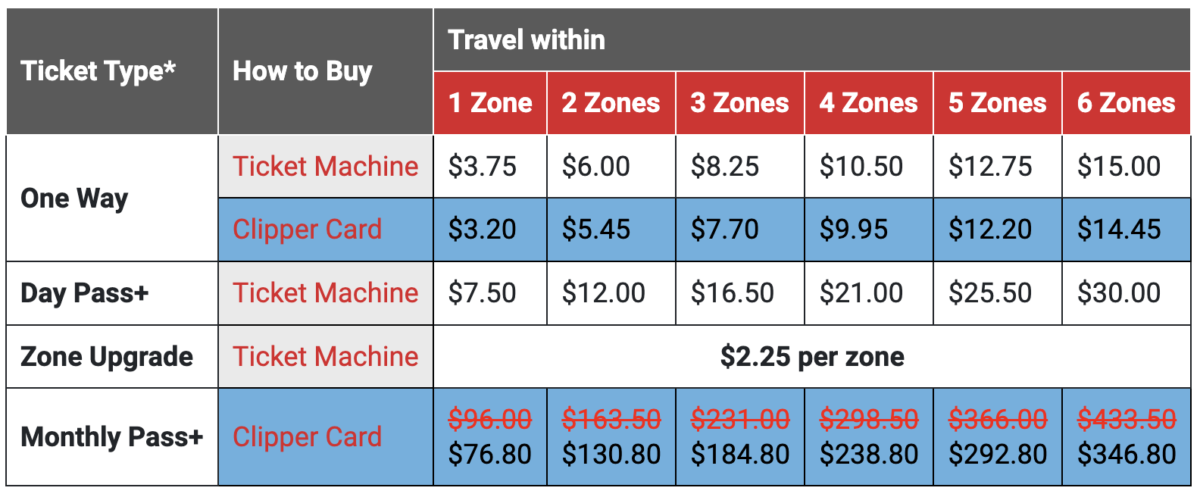
The train from my house to San Francisco costs $6.00 each way (2 zones). To get to the station, you have to take an Uber, a scooter, or a bike—it’s about a 15-minute ride by scooter or bike. The train fare offers some discounts depending on how you use it:
Food
I cook at home and I’m vegan. But Mike and I also split the grocery bill in half. Mike isn’t vegan; he usually eats frozen shrimp, salmon, or chicken. We also buy a lot of vegetables and fruits, and most of them are pre-prepared, frozen, or pre-washed (yes, microwave rice, frozen broccoli that’s ready in 4 minutes in the microwave). We also have Teddy, our dog, and he eats really fancy food. We don’t buy a lot of junk food, but we do buy a lot of drinks, lol
We usually go to Costco every 10 days and spend about $550.00 a month.
We go to other supermarkets and also use Amazon for some miscellaneous or recurring items (like toilet paper), which probably costs us another $450.00 a month.
Total: $1,000.00 per month (for 2 humans + 1 dog).
Leisure & Other
This is a pretty complex category, since we do a lot of different activities.
Here are a few examples of restaurants (total bill for two people, including taxes and tip):
- President’s Terrace Rooftop Bar (https://www.yelp.com/biz/presidents-terrace-palo-alto?osq=Presidents + Terrace): $200.14
- Five Guys: $35.00
- Mumu Hot Pot: $90.56
- Cafe Savini: $43.74
We also travel a lot, so we stay at various Airbnbs or go camping. It really depends on the type of trip.
I pay $65.00 for a gym membership that includes access every day of the week, including group classes https://www.crunch.com/. At this gym, a personal training session costs $100.00.
Eyebrow shaping costs $45.00 (I usually tip between $5 and $10);
Manicure and pedicure cost $50.00 (I usually tip between $5 and $10);
Conclusion
These are a few examples of my cost of living, but it varies greatly from person to person.
Here are some websites that might be helpful:
- Houses/apartments for rent: https://www.zillow.com/
- California homebuyer incentive program: https://www.calhfa.ca.gov/homebuyer/programs/index.htm
- Cost-of-living comparison between two locations: https://www.numbeo.com/cost-of-living/comparison.jsp
- Where to research salaries: https://www.levels.fyi/
Let me know—what’s missing from this list?
